Friendship
Like a Dragon

The following is a short article I published on Medium a few years ago. I decided to move this post along with some of my other ones to substack. If you like this kind of content, feel free to subscribe. If your friends like this kind of content, then please share it with them.
In recent years, the Like a Dragon video game series has grown in popularity in the West. Formerly known as Yakuza, the series underwent a title change recently to better reflect the content of the game and to better match the Japanese title 龍が如く (ryuu ga gotoku). Each game in the series is packed with familiar content. From minigames and absurd sub-stories to soap opera-esque plot points, each game elicits a range of emotions. My wife often walks into the room when I’m playing Like a Dragon (LAD) games, laughs at the nonsense on the screen, and walks out. When I tell her that I usually shed a few tears during the final parts of a LAD game, she is skeptical that anyone could find something serious enough in a LAD game to cry about.
But, that’s just the thing about LAD — the turmoil the characters go through feels real. Their friendships and relationships feel genuine enough that when those relationships come to an end, the player feels a great sense of loss. What is it about the friendships in LAD that pulls at our heartstrings? In this short essay, I will explore Kiryu Kazuma’s friendship with Nishikiyama Akira in the first LAD game (LAD 1) and the prequel (LAD 0). Of course, all of the games are filled with fantastic examples of friendships, but I do not want to risk spoiling the newer games.
The remainder of this essay will contain extensive spoilers for LAD 0 and LAD 1 (Kiwami).

Aristotle wrote the book on a lot of different topics. There’s a reason he was sometimes called The Philosopher during the medieval period. Among his many writings, Aristotle gives a theory of friendship. According to Aristotle, there are three kinds of friendships — friendships of pleasure, of utility, and of virtue.
Friendships of pleasure occur when the friendship exists because the friends derive pleasure from each other’s company. For example, in LAD 0 Kiryu develops a friendship with Pocket Circuit Fighter, the employee at the slot car racing circuit. This friendship arises because of the pleasure they get from spending time together racing slot cars.
Friendships of utility are very similar to ones of pleasure. A friendship of utility develops because one or both friends are useful to the other. For an easy example of a friendship of utility in the LAD series, consider the friendship between Kiryu and the police officer Date Makoto as it is depicted in LAD 1. Date helps Kiryu during his adventures after getting out of jail and Kiryu helps Date in his investigation of the missing ¥10,000,000,000.
Finally, friendships of virtue arise when two friends who are both virtuous people enter into a friendship because they are both virtuous. Aristotle calls this the perfect kind of friendship.
The perfect form of friendship is that between the good, and those who resemble each other in virtue. (Nicomachean Ethics Book 8)
It is this last type of friendship that I will focus on in the rest of this essay. I will argue that the friendship between Kiryu and Nishikiyama starts as a friendship of virtue and ends because Nishikiyama becomes less virtuous.
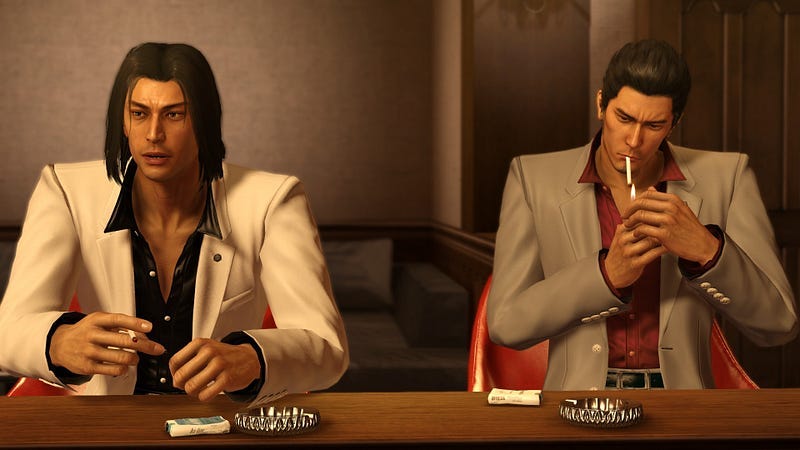
But before we get into the analysis of the story of Kiryu and Nishiki, one point about Aristotle needs clarification. Aristotle believed that friendships of virtue were so perfect that they could not end.
Such friendship is naturally permanent, since it combines in itself all the attributes that friends ought to possess. (Nichomachean Ethics Book 8)
Aristotle seems to say in Book 8 of the Nichomachean Ethics that the kind of truly virtuous people who can enter into friendships of virtue cannot lose their virtue. This point seems a bit weird. After all, Aristotle treats virtue as something that must be gained through practice. Virtues are habits that have to be built up by repetition. But, even the most ingrained habit can be lost. So, it seems likely that even the virtuous person can become vicious, and so friendships of virtue can end.
At the very least, this will be the conception of virtue and friendships of virtue I will be working with in this essay.
Kiryu and Nishikiyama became friends when they were children at the orphanage named Sunflower. Both of them were heavily influenced by Kazama Shintaro, the benefactor of the orphanage and the head of the Kazama family — a subsidiary of the Dojima family. Because of Kazama’s influence and despite his forewarnings, both Kiryu and Nishiki join the yakuza.
Children’s friendships often start as friendships of pleasure. Virtue, according to Aristotle, must be acquired through practice. Since children have had less practice, they are not yet virtuous. But, what does it mean for a person to be virtuous. Surely Kiryu and Nishiki, members of organized crime families, do not count as virtuous.
Virtue is about developing a habit of taking balanced and moderate actions. One of the primary examples of a virtue is courage. Being courageous isn’t about taking on needless risk. Jumping off a bridge to prove that you are brave to your friends is not courageous — it is reckless. On the flip side, refusing to ride a roller coaster is not courageous either, it is cowardice. Courage falls in the middle ground between recklessness and cowardice.
Of course, Kiryu and Nishiki will not be completely virtuous individuals. Their work for the Tojo Clan will undoubtedly require vicious actions. For example, one of the commonly cited virtues is beneficience — being kind to those weaker than you. Though Kiryu shows beneficience throughout most of the series, his work for the Tojo Clan in the leadup to LAD 1 would definitely mean he is not beneficient at that time. That being said, there are other virtues like courage and loyalty that both Kiryu and Nishiki have in spades. If their friendship is based on their recognizing these virtues in each other, then their friendship is a friendship of virtue.
Note that the particular virtues that Kiryu and Nishiki have — courage and loyalty — are the traits that are glamorized in media depictions of the yakuza. Note that we do not need to be concerned with the accuracy of thes depictions of the yakuza and their place within Japanese society. My concern in this essay is just to analyze the video games, not the actual yakuza.
Kiryu bravely goes into fights to help both people he cares for and complete strangers, but he only fights when there is a good reason to do so. Majima Goro challenges Kiryu to a fight early in LAD 1 and we see that Kiryu refuses to fight him. He is quick, however, to save the dog that he and Haruka find. He is courageous without being reckless. As for loyalty, Kiryu keeps coming back to the Tojo Clan year after year to help with the troubles they constantly find themselves in. He is also incredibly loyal to Kazama. But, remember that virtues fall in the middle ground — they are not extremes. In LAD 0, Kiryu willingly fights back against the Tojo clan when they show themselves to be less than virtuous. In this way, he tempers his loyalty and does not remain loyal to the vicious.
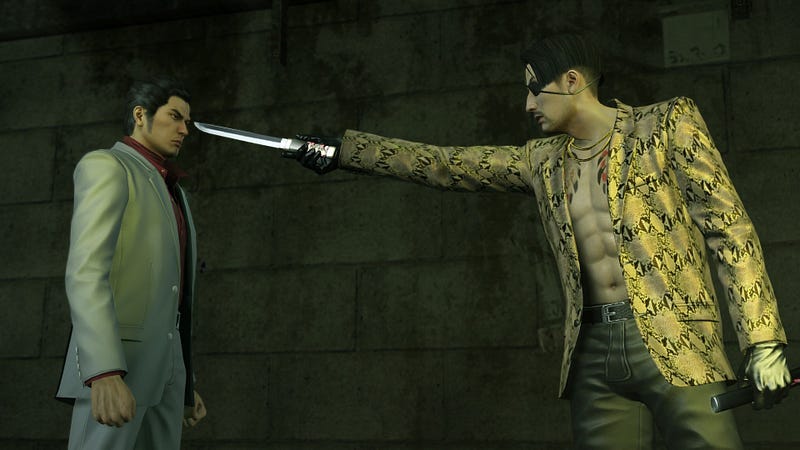
It is a little harder to see how Nishiki counts as virtuous, but he does exhibit the virtues of courage and loyalty. Since Nishiki plays the role of the villain in LAD 1, we do not get to see him as much as we do in LAD 0. In LAD 0, we see a courageous and loyal individual. Nishiki’s courage and loyalty are complicated topics in LAD 0. In one of the most dramatic scenes in the series, Nishiki takes Kiryu out to a forest with the intention of killing him. Nishiki’s goal is to make sure Kiryu does not have to go through the torture that the Tojo clan will subject Kiryu to when they catch him. Ultimately Nishiki’s resolution wavers and he does not go through with the murder. In this seen Nishiki shows his weakness. Bringing Kiryu out to the forest in the first place showed a lack of courage in facing down the Tojo Clan. And, failing to go through with the murder shows a lack of courage in sticking with his convictions (or maybe it shows a lack of recklessness). At the same time, Nishiki’s actions demonstrate a kind of loyalty to his friend. During the course of LAD 0, Nishiki is always focused on what is best for his friend.
Nishiki develops during the course of LAD 0, as one is apt to do when they are faced with ethical dilemmas. Aristotle believed that one can become more virtuous through practice. Facing ethical dilemmas gives us chances to practice the virtues we wish to develop. In chapter 14, titled “Unwavering Bond,” Nishiki is commanded to show his loyalty to the Tojo clan by killing Kiryu. Nishiki disobeys this command and instead turns to fight against the Tojo clan beside his sworn brother. In this way, Nishiki makes the same move as Kiryu, he is loyal, but not to the point of following those who are vicious. In addition, he is incredibly loyal to Kiryu. In this fight, he also exemplifies his courage by rebelling against the powerful Tojo clan.
At the beginning of LAD 1, we see that Nishiki cares for his sister and works hard to pay for her surgery. He is happy for his friend’s success when Kiryu gets the opportunity to lead his own yakuza family. We don’t see as many examples of Nishiki’s virtues in the series as we do of Kiryu’s, but they definitely exist. And it is the presence of these virtues throughout LAD 0 and LAD 1 that make the friendship between Kiryu and Nishikiyama feel so tangible.
The friendship between the two is a friendship of virtue. They recognize the virtues in one another and their friendship persists because of those virtues.
Majima remarks that Kiryu changed during his 10 years in prison — that he had become too weak. But Kiryu quickly regains his physical capabilities. The character that actually changed during those years was Nishikiyama. When Kiryu returns he finds that his old friend is plotting to take over the Tojo clan. He is told by his old friends that Nishiki has changed.
During the time when Kiryu is in prison, Nishiki is told that he will need ¥30,000,000 to have a doctor attempt a surgery that will save his sister’s life. This is the beginning of Nishiki’s fall. He resorts to more aggressive money-gathering schemes that reveal disloyalty to his friend Kashiwagi — Kazama Shintaro’s right hand man. After acquiring the necessary funds, Nishiki finds out that the doctor had tricked him and his sister was doomed. This turn of events ruins Nishiki. He becomes callous and scheming, willing to throw others beneath him to climb the ranks of the Tojo clan. His courage is still there, but any other virtues he may have had were lost.

Unraveling the web of intrigue about the missing ¥10,000,000,000, Kiryu comes face to face with Nishikiyama in a final showdown. The two battle in front of the ¥10,000,000,000 that Nishiki wants to use to install himself as the next chairman of the Tojo clan. His actions up to this point indicate that he is no longer a virtuous man. He is no longer loyal to his friends or to his clan.
Kiryu, ever the virtuous man, insists that some good is left in Nishiki, but at this point in the story, their friendship has ended. The emotional weight of their battle atop the Millennium Tower comes from the hopelessness of saving a friendship of virtue. Friendships of pleasure and utility come and go. The sadness that comes from the ending of such friendships is temporary, since it only comes from the loss of pleasure or usefulness. But, the end of a friendship of virtue means that something genuinely good has left the world. In the case of the friendship of Kiryu and Nishiki, a virtuous man has strayed down the path of evil.
But, just like how virtues are hard to cultivate, they are also hard to lose. Kiryu is right that something of the virtuous Nishiki is still present. In the end, Nishiki sacrifices himself to save Kiryu and Haruka. This final act of courage, loyalty, and beneficence adds a bittersweet ending to the story. The friendship of virtue between Nishiki and Kiryu was salvageable, but the act that redeems Nishiki makes it impossible to recover their friendship.
The Like a Dragon series is full of friendships of virtue that give meaning to the interactions between the characters. I mentioned Date Makoto at the beginning of this short essay. Though the friendship between Kiryu and Date at the beginning of the series is a friendship of utility, it evolves into a friendship of virtue as the two learn more about each other.
Stories that focus more on friendships of pleasure or utility can be interesting, but those friendships do not pull at the heartstrings in the way that friendships of virtue do. Since LAD includes so many friendships of virtue and allows them to end, it contains the emotional beats that draw in so many players.